Science & Technology: Thinking Outside of the Toy Box
Four Children's Gizmos That Inspired Scientific Breakthroughs (Scientific American 2010-03-24)
Advances in science and technology can launch from unassuming springboards.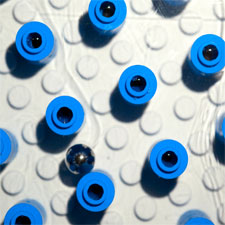 In 1609 Galileo tweaked a toylike spyglass, pointed it at the moon and Jupiter (not the neighbors), and astronomy took a quantum leap. About 150 years later, Benjamin Franklin reportedly used a kite to experiment with one of the earliest-known electrical capacitors. Continuing that tradition, researchers reach back to childhood -- to Etch A Sketch, Lego, Shrinky Dink and Balloon within a Balloon -- to help them develop tiny transistors, study particle separation, make microfluidics devices, and fight cancer.
Advances in science and technology can launch from unassuming springboards.
In 1609 Galileo tweaked a toylike spyglass, pointed it at the moon and Jupiter (not the neighbors), and astronomy took a quantum leap. About 150 years later, Benjamin Franklin reportedly used a kite to experiment with one of the earliest-known electrical capacitors. Continuing that tradition, researchers reach back to childhood -- to Etch A Sketch, Lego, Shrinky Dink and Balloon within a Balloon -- to help them develop tiny transistors, study particle separation, make microfluidics devices, and fight cancer.Labels: science, technology
posted by John Gabree at 3/26/2010


 internet before you think of the ocean. But those two words go together to help wave riders predict whether worthwhile swells are heading their way. By looking at satellite and climate data that's available on the web, surfers can follow storms into shore and be there in time to catch the biggest waves." -- from the website. <


